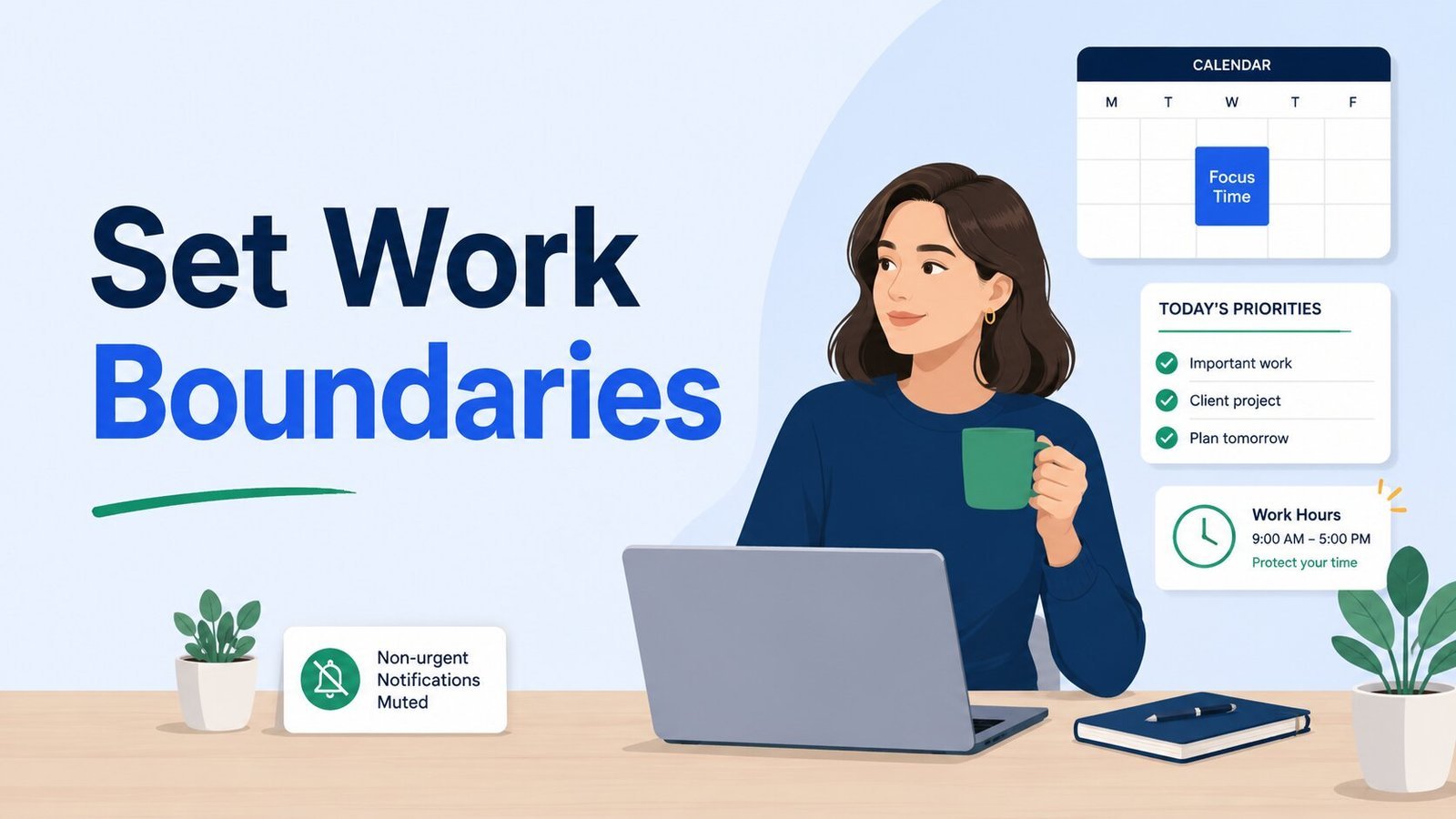
Saying yes at work can become automatic. You take on one more task, answer one more message after hours, or sit through another meeting because pushing back seems harder than fitting it in.
Over time, that can leave very little room for focused work, realistic priorities, or a proper end to the workday. Setting a boundary does not have to mean becoming difficult or unhelpful. It can simply mean being clearer about what you can take on, when you are available, and what needs to change when there is too much competing for your time.
The hardest part is often not knowing that you need a boundary. It is finding a way to communicate it without creating unnecessary tension or feeling guilty for having limits.
Quick Overview
- Work boundaries define what you can reasonably take on, when you are available, and how you want certain work interactions to happen.
- Common boundaries involve workload, working hours, communication, meetings, and personal conversations.
- Clear boundaries work best when you state the limit calmly and, when possible, offer a practical next step.
- Consistency matters. A boundary becomes easier for other people to understand when your actions continue to support it.
Why Work Boundaries Are Easy to Put Off
Work boundaries often get delayed because saying yes feels easier in the moment.
You may hesitate because:
- You do not want to seem unhelpful. Pushing back on a request can seem risky when you want to be seen as dependable.
- The current pattern is already established. If you normally answer after hours or accept extra work, changing that expectation can be awkward.
- You are not sure whether the request is unreasonable. That uncertainty can turn into another yes, even when your schedule is already full.
- The workplace culture rewards constant availability. Quick replies, long hours, or always being reachable can become normal even when nobody formally requires them.
That does not mean every uncomfortable request needs a firm no. It means noticing when the same pattern keeps creating pressure and deciding whether a clearer limit would make the work more manageable.
Repeatedly taking on more than you can reasonably handle can also become a source of stress at work, especially when the pressure carries from one workday into the next.
What Healthy Work Boundaries Look Like
Work boundaries are not only about saying no. They help make expectations clearer around your time, workload, availability, and interactions with other people.
The boundary you need depends on where the pressure is coming from.
Time Boundaries
These protect when you are available for work.
They may involve your working hours, breaks, focus time, or when you stop checking messages for the day.
A time boundary might mean avoiding routine replies after work hours or protecting part of the morning for uninterrupted work. If work continues occupying your attention long after you finish, a clearer routine for how you disconnect from work after hours may help too.

Workload Boundaries
These prevent every new request from automatically becoming your responsibility.
A workload boundary can mean asking which task should take priority, pushing back on an unrealistic deadline, or being clear when your current workload cannot absorb another assignment without something else moving.
When several requests genuinely compete for the same limited time, prioritizing tasks at work can help you make the tradeoff clearer before agreeing to more.
Communication Boundaries
These set expectations around how and when people contact you.
That may include reducing unnecessary direct messages, using the right channel for non-urgent requests, or making it clear that routine communication does not require an immediate reply.
Meeting Boundaries
Meetings can take time away from focused work, especially when they are added without a clear purpose.
A meeting boundary might mean asking for an agenda, declining a meeting where your input is not needed, or suggesting a written update when a live discussion would add little value.
If recurring meetings are taking a large part of the workday, the wider problem may be meeting overload rather than one individual invitation.
Personal and Emotional Boundaries
You are not required to share every part of your personal life at work or take responsibility for every coworker’s emotions.
These boundaries can involve declining personal questions, stepping away from workplace gossip, or keeping a difficult conversation focused on the work rather than allowing it to become personal.
Healthy boundaries do not have to be rigid. They should make your limits and expectations easier for other people to understand while still leaving room for reasonable flexibility when the situation calls for it.
Start With the Boundary That Is Creating the Most Pressure
You do not need to change every boundary at once. Start with the pattern causing the most disruption in your workday.
A few recurring signs can point to where a clearer limit may help:
| If you often notice… | You may need a boundary around… |
|---|---|
| You keep accepting new work even when your schedule is already full | Workload and priorities |
| Messages regularly pull you back into work after hours | Availability |
| Coworkers interrupt focused work for non-urgent questions | Communication and focus time |
| Your calendar fills with meetings where you have little to contribute | Meetings |
| You regularly skip breaks or work through the end of the day | Time and recovery |
| Personal questions or workplace gossip leave you uncomfortable | Personal conversations |
Look for the pattern costing you the most time, focus, or energy. That is usually a better place to begin than creating a long list of new rules for yourself.
For example, if after-hours messages are the main problem, you may not need to change your meeting habits, workload, and communication channels at the same time. Decide what availability you can realistically maintain and what should happen when something genuinely cannot wait.
A boundary is easier to keep when it solves a problem you can clearly recognize.
A Simple Formula for Setting Boundaries Politely
A workplace boundary usually lands better when it is clear, calm, and specific.
You do not need a long explanation. In many situations, three parts are enough:
Acknowledge the request + state your limit + offer the next step
For example:
I can take this on, but I will not be able to finish it today. I can have it ready by Thursday afternoon.
Or:
I am not available after 6 PM, but I can pick this up first thing tomorrow morning.
The first part shows that you have understood the request. The second makes the limit clear. The third gives the conversation somewhere useful to go.
A useful way to think about workplace boundaries is that they define your own limits and actions, rather than creating rules that force other people to behave a certain way. That distinction also appears in Harvard Business Review’s discussion of setting and maintaining workplace boundaries.
Compare:
Stop messaging me after work.
with:
I usually check work messages during working hours. If something comes through in the evening, I will respond the next morning unless it is genuinely urgent.
Both address the same underlying problem, but the second makes your availability clear without trying to control when someone else can send a message.
You also do not need to apologize repeatedly or build a long case for why the boundary is reasonable. A short explanation can help when context matters, but overexplaining can make a clear limit sound negotiable.
You do not need perfect wording. The other person simply needs to understand what you can do and what they should expect next.
Boundary Scripts for Common Work Situations
The wording will change depending on your role and workplace. The clearest boundaries usually say what is possible, what is not, and what should happen next.

When Your Manager Gives You More Work
If your workload is already full, make the tradeoff visible instead of automatically accepting another task.
I can take this on, but I am already working toward Friday’s deadline for the client report. Which one should take priority?
If the new task is important but the timing is unrealistic:
I can complete this by Wednesday. To finish it by Monday, I would need to move one of my current deadlines.
This keeps the conversation focused on priorities and capacity rather than simply saying you are too busy.
When You Receive Messages After Hours
You do not have to respond immediately simply because a message arrives.
I usually check work messages during working hours, so anything sent in the evening will normally get a response the next morning.
If some situations genuinely require faster attention, make the exception clear:
If something is urgent after hours, please call me. Otherwise, I will pick it up when I am back online.
When a Coworker Keeps Interrupting You
A boundary can protect focus time without shutting the other person out.
I am in the middle of something that needs my full attention. Can we look at this after 2 PM?
For recurring interruptions:
I am trying to protect the first part of my morning for focused work. If it is not urgent, could you send it to me and I will check it after 11?
When You Want to Decline a Meeting
You can question whether your attendance is necessary without dismissing the meeting itself.
I do not think I need to be in the full meeting. If you send me the decisions or any questions for my part afterward, I can follow up from there.
Or, when the topic could be handled without a meeting:
Could we handle this through a written update instead? I think the information we need can be shared without everyone joining a call.
When You Need to Change Something You Already Agreed To
A boundary does not have to remain fixed simply because you agreed to something earlier. Sometimes an arrangement stops working.
I know I have been handling these requests at the end of the day, but it is starting to interfere with other deadlines. Going forward, I need them by 3 PM if they need same-day attention.
You can acknowledge the previous pattern without promising to continue it.
When a Conversation Becomes Too Personal
You do not owe coworkers details you would rather keep private.
I would rather keep that part of my life separate from work.
Or, if you want to redirect the conversation:
I am keeping that one private, but how is your project going?
A short response is often enough. You do not need to justify why you would rather keep something personal.
When a Boundary Feels Uncomfortable or Gets Tested
Setting a boundary does not always make the situation comfortable straight away.
You may question whether you were too firm, worry that someone is disappointed, or be tempted to make an exception immediately. A boundary can also be tested simply because other people are accustomed to the old pattern.

When You Feel Guilty
Feeling guilty does not automatically mean the boundary was unreasonable.
Ask yourself whether you were clear, respectful, and realistic about what you could do. If the answer is yes, the discomfort may simply come from changing a pattern you have followed for a long time.
It helps to separate being helpful from being endlessly available. You can support your team without accepting every request, responding at every hour, or taking responsibility for work that cannot realistically fit into your schedule.
Try not to undo a reasonable boundary simply because saying yes would make the moment easier.
When Someone Keeps Crossing the Boundary
A boundary usually needs consistency before other people know what to expect.
If someone ignores it once, a simple reminder may be enough:
I am not able to take this on today. I can look at it tomorrow morning.
If the same pattern keeps returning, be more specific:
I have mentioned that I am not available for routine requests after 6 PM. I will respond to these when I am back online the next morning.
You do not need to make the wording harsher each time. Keep the message clear and let your actions support it.
If you have said that non-urgent evening messages will be handled the next morning but continue answering them immediately, the old expectation is likely to remain.
When repeated reminders do not help, or the situation begins affecting your workload, well-being, or ability to do your job, the next step may need to involve a manager, HR, or another appropriate workplace channel.
When the Problem Is Bigger Than a Boundary
A clear boundary can improve many everyday work situations. It cannot fix every workplace problem.
If the underlying issue is chronic understaffing, unrealistic expectations, repeated disrespect, harassment, retaliation, unsafe behavior, or a workplace that consistently ignores reasonable limits, another boundary conversation may not be enough.
In those situations, it can help to document what is happening and use the appropriate support available to you, such as a manager, HR, a formal reporting process, or another relevant workplace channel.
The same applies when the pressure is seriously affecting your ability to work or recover outside work. A boundary may still be part of the response, but it should not place the entire responsibility on you to manage a problem created by the workplace itself.
A useful boundary can protect part of your time, workload, or availability. It should not be expected to make an unhealthy situation acceptable.
ACTION PLAN
Put One Boundary Into Practice
Choose one recurring situation that is making your workday harder. Focus on making that boundary clearer before trying to change several habits at once.
- Identify the situation that keeps creating pressure.
- Decide what limit would make it more manageable.
- Choose clear wording for how you will communicate it.
- Offer a practical next step when one is needed.
- Follow through consistently so the new expectation has time to settle.
Frequently Asked Questions
How do you set boundaries at work without feeling guilty?
Start with a limit that solves a recurring problem, communicate it respectfully, and follow through. Feeling uncomfortable after setting a reasonable boundary does not necessarily mean the boundary was wrong.
How do you set boundaries with your boss?
Keep the conversation focused on workload, priorities, timing, or availability. Explain what you can realistically do and, when priorities conflict, ask which task or deadline should move.
What are examples of healthy boundaries at work?
Healthy boundaries can include limiting routine after-hours replies, protecting focus time, being realistic about workload, declining unnecessary meetings, and keeping personal conversations within a level that feels comfortable.
How do you say no professionally at work?
Be clear without being abrupt. Acknowledge the request, state what you can or cannot take on, and offer a workable alternative or next step when one is available.