
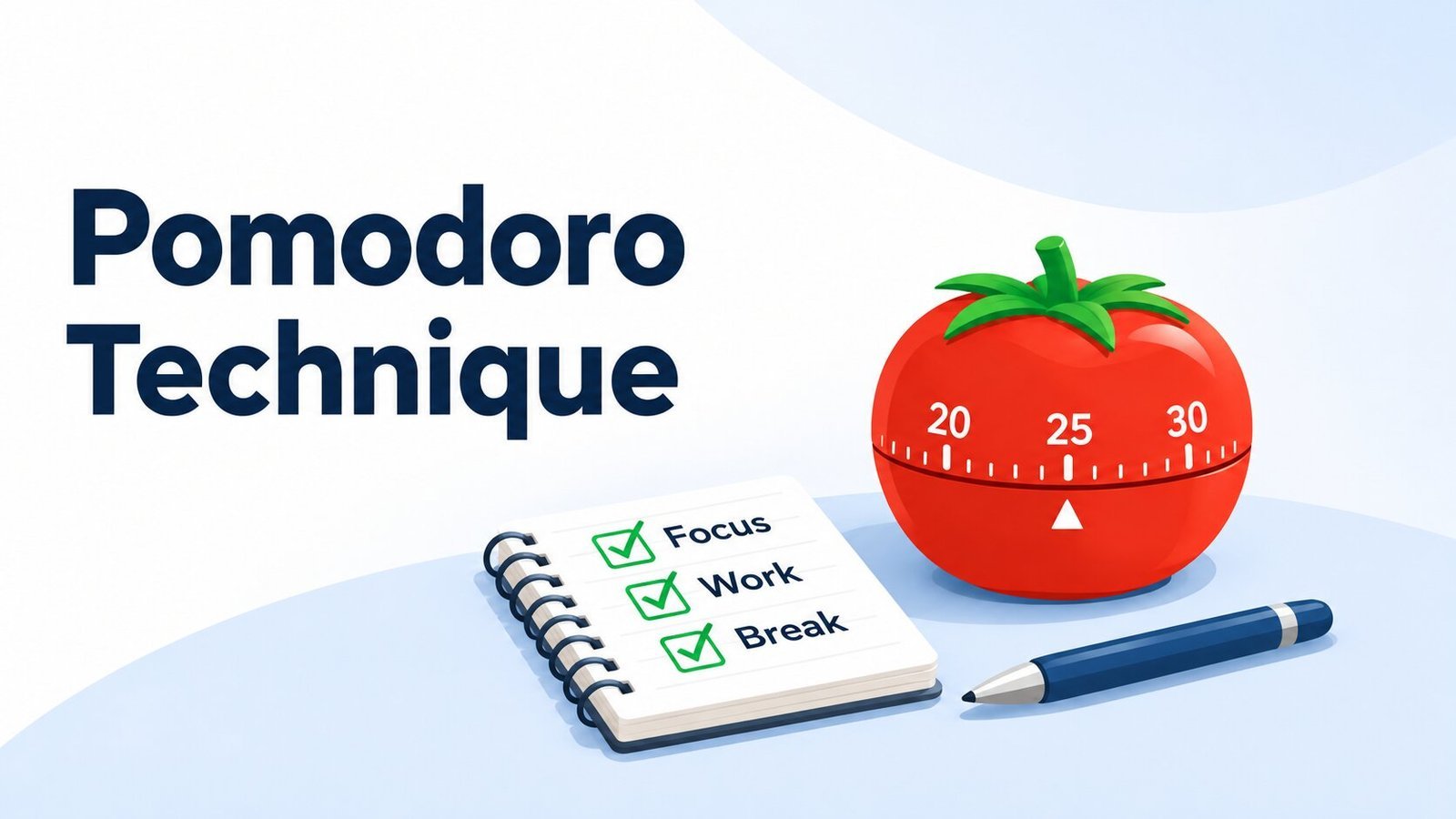
Twenty-five minutes sounds manageable when you’re struggling to get started on something. You only need to concentrate for a short while, take a break, and then decide what comes next.
That’s part of the appeal of the Pomodoro Technique. It gives your work a rhythm without asking you to plan every minute of the day.
But following a timer isn’t always straightforward. Some tasks take longer to settle into, and a perfectly timed break can arrive just when you’re making good progress. The method can still be useful, provided you understand what it’s meant to do and where a little flexibility makes sense.
What Is the Pomodoro Technique?
The Pomodoro Technique is a time-management method that divides work into focused sessions separated by regular breaks.
In its traditional form, you follow this pattern:
- Work on one task for 25 minutes.
- Take a 5-minute break.
- Repeat the cycle.
- After four completed work sessions, take a longer break of around 15–30 minutes.
Each 25-minute work session is called a Pomodoro.
The method was developed by Francesco Cirillo in the 1980s when he was a university student. He used a tomato-shaped kitchen timer to help himself concentrate, which is where the name comes from. Pomodoro means tomato in Italian.
The timer is only one part of the original technique, though.
Cirillo’s official explanation of the Pomodoro Technique also includes planning tasks, estimating effort, managing interruptions, recording progress, and reflecting on how you use your time.
You don’t need to adopt the entire system on your first day. A timer, a specific task, and a willingness to take the breaks are enough to begin understanding how the method feels in practice.
The important part is giving one piece of work your attention for a defined period, then stepping away before beginning another session.
How to Use the Pomodoro Technique at Work
You can try the method with an ordinary phone timer, a browser timer, or a dedicated Pomodoro app. There’s no need to install complicated software or reorganize your entire schedule.
Start with one or two sessions. That gives you a chance to see how the routine fits your work before committing to several cycles.
1. Choose One Specific Piece of Work
Before starting the timer, decide what you’re going to work on and roughly how many Pomodoros you think it might take.
Something broad like “prepare training materials” doesn’t give you much direction. You could spend half the session deciding whether to research the topic, update an old document, or work on the slides.
A clearer starting point would be:
Draft the outline for the employee onboarding handout.
You might estimate that the outline will take one Pomodoro and drafting the main instructions will take another two.
These are estimates, not deadlines. If the outline takes longer because you discover missing information, that’s useful to know.
You don’t have to finish an entire task in 25 minutes. What helps is knowing which part deserves your attention during the current session.
If the work is still unclear, you could use the first session to understand the requirements and identify the next steps.
2. Set a Timer for 25 Minutes
Start the timer and work on your chosen task.
During this period, try to stay with that work rather than switching between unrelated activities.
You might remember a question you need to ask someone, notice another task that needs attention, or think of something worth checking later.
If it can wait, write it down briefly and continue. Keeping a small note beside your task list gives those thoughts somewhere to go without requiring you to leave the session.
And if you’re repeatedly distracted, notice what’s happening. A record of interruptions may eventually show that a particular time of day or type of work isn’t suited to uninterrupted sessions.
3. Take the Break When the Timer Rings
When the 25 minutes end, stop for a short break.
The traditional method treats the work interval as a defined session rather than something you keep extending whenever you’re making progress.
For your five-minute break, step away from the task if you can.
Stand up, stretch, get some water, or look away from the screen for a while. You don’t need to make the break productive.
Opening another demanding work task isn’t much of a break, even if it feels different from what you were doing.
If the work requires you to remain at your desk, you can still use the pause to rest your attention rather than immediately filling it with another activity.
4. Start Another Session When You’re Ready
After the break, return to the task or choose the next piece of work.
Suppose you spent your first Pomodoro outlining a training handout. You might use the second session to draft its opening section and the third to develop the main instructions.
You don’t need to invent a completely new task for every session.
If you finish your chosen work before the timer ends, you can use the remaining time to review what you’ve done, make a useful correction, or prepare the next relevant step. In the traditional method, the Pomodoro still runs for its full interval.
There’s little value in creating unnecessary work just to keep the clock running.
5. Record Your Progress and Review Your Estimates
At the end of a session, make a brief note of what happened.
It can be as simple as:
Completed the handout outline. Still need examples for sections two and three.
You can also compare the number of Pomodoros you expected a task to take with the number you actually needed.
For example, you estimated two sessions to draft the main instructions, but the work took four. Perhaps the material needed more research, or the task was larger than you initially thought.
The next time you plan similar work, you have a better reference point.
This is one of the useful parts of the broader Pomodoro system. Tracking sessions isn’t only about counting how many you’ve completed. It can help you understand how much time your work realistically requires.
You don’t need a detailed spreadsheet to do that. A short note beside the task is enough to begin.
After four completed Pomodoros, the traditional pattern includes a longer break. That doesn’t mean you have to fit four sessions into every working period. Your schedule and responsibilities still determine how much uninterrupted time you have available.
What to Do When a Pomodoro Gets Interrupted
This is where the method becomes more complicated at work.
It’s relatively easy to avoid checking an unrelated website for 25 minutes. It’s another matter when a colleague needs an answer, a customer reports a problem, or an unexpected request changes your priorities.
The original Pomodoro Technique distinguishes between interruptions you create yourself and interruptions coming from other people or events.
Both need attention, but not necessarily the same response.
When You Interrupt Yourself
You might be reviewing a document when you remember an expense claim you forgot to submit.
The thought is useful. Acting on it immediately may not be necessary.
Write a quick reminder and return to the document. You can handle the expense claim after the session or during another suitable period.
If you want to follow the more complete Pomodoro system, you can also mark the interruption in your session record. Over several sessions, those notes may reveal whether you’re regularly switching to unrelated work or whether a particular task keeps prompting additional questions.
That can be more useful than simply telling yourself to concentrate harder.
Of course, not every distraction can be solved by writing it down. If you’re repeatedly leaving the task because you don’t know what to do next, the work itself may need a clearer starting point.
When Someone Else Interrupts You
Suppose you’re preparing a project handoff document and a colleague asks you to check a file.
Before switching, consider whether the request genuinely needs attention now.
If it can wait, you might say:
I’m working on the handoff document right now. Can I check that file in about 20 minutes and get back to you?
That gives the other person a reasonable expectation without dismissing their request.
The original method uses a similar principle: make the interruption visible, negotiate when you’ll respond, and return to it later.
You can note the request alongside your current session, then address it at the agreed time.
But you shouldn’t treat every incoming request as an unwanted distraction. Answering questions, helping colleagues, and handling problems are legitimate parts of many jobs.
If your responsibilities require quick responses, keeping an urgent communication channel available may be necessary.
When the Interruption Cannot Wait
Imagine you’re halfway through a session when a customer issue arises that needs immediate attention.
Handle the issue.
Under the strict Pomodoro rules, a session disrupted by an interruption that cannot be deferred is generally treated as an incomplete Pomodoro. You can start a new one when you’re able to return to focused work.
That doesn’t make the work you completed before the interruption worthless.
For a brief interruption, you may prefer to pause and resume the timer. For a substantial interruption, starting fresh may be easier. Both are practical adaptations rather than strict use of the original method.
If several sessions keep getting interrupted by necessary work, pay attention to that pattern. It may indicate that the period you’ve chosen isn’t suitable for Pomodoros, rather than a problem with your concentration.
You could reserve sessions for quieter periods, shorten the intervals, or use a less structured approach.
A timer shouldn’t turn ordinary workplace responsibilities into something you’re constantly trying to avoid.
Do You Have to Follow the 25-Minute Rule?
The traditional Pomodoro Technique uses 25-minute work sessions followed by five-minute breaks.
But those exact intervals aren’t necessarily the most useful choice for every task.
A 25-minute session may suit reviewing a document, while a difficult technical problem could require more sustained attention. If starting is the challenge, even 25 minutes might feel like a substantial commitment.
You can experiment with different intervals while keeping the general idea of focused work and deliberate breaks.
Shorter Sessions for Difficult Starts
If beginning is the hardest part, try a 10- or 15-minute focus period.
Choose something specific and work on it until the timer ends.
You might find that the smaller commitment makes it easier to begin a task you’ve been postponing.
Once you’re working comfortably, you can decide whether to try a longer interval.
Shorter sessions can also fit into small gaps in your workday, although not every task is suitable for those gaps.
Longer Sessions for Demanding Work
Writing a complicated report, reviewing technical material, or solving a difficult problem may require more sustained attention.
In those situations, you could try a 40- or 50-minute session followed by a longer break.
Those durations are examples, not scientifically established ideal intervals.
The point is to choose a period that gives you enough time to engage meaningfully with the task while still making room to rest.
If it takes you 15 minutes to understand a problem, stopping just ten minutes later may feel unnecessarily disruptive.
What If the Timer Rings When You’re Concentrating Well?
This is a reasonable objection to fixed intervals.
If you’re following the traditional technique, you stop when the session ends and take the planned break.
If you’re using a flexible variation, you might finish the current paragraph, calculation, or other natural step before stopping.
For work that depends on sustained concentration, you could also choose to take breaks at meaningful stopping points rather than using a fixed timer.
That becomes a different break-taking approach, which is perfectly acceptable if it serves the work better.
It’s useful to be clear about the distinction. A 50-minute focus session or a break taken whenever you reach a natural stopping point isn’t the original 25-minute Pomodoro pattern.
You can still borrow what you find helpful without calling every variation the traditional method.
When the Pomodoro Technique Helps, and When It Doesn’t
The Pomodoro Technique can be particularly useful when you have enough control over your working time to protect short periods of attention.
For example, it may suit:
- Work that’s difficult to begin. A short session can make the initial commitment feel more manageable.
- Tasks with several manageable parts. Reviewing documents, drafting sections, or organizing research can fit into repeated sessions.
- Work where you regularly drift into unrelated activities. A defined focus period gives you a point to return to.
- Days when you forget to step away. Planned breaks can remind you to stop rather than continuing indefinitely.
Some people may find the timer reassuring because it puts a boundary around the effort they’re making.
Others may find it distracting, especially if they’re checking how many minutes remain or feeling pressure to complete a particular amount of work before the alarm.
That difference matters.
Choosing a Focus Routine That Fits Your Work
Consider three people who want to get more focused work done.
One has 90 minutes available to prepare a report.
The work can be divided into reviewing notes, preparing an outline, and drafting the first section.
Traditional Pomodoro sessions could work well here. Two or three focused sessions, with short breaks between them, would provide a clear structure without requiring the person to reorganize the rest of their day.
They can estimate how many sessions the work will take and review that estimate afterward.
Another is investigating a complicated software problem.
The first part of the work involves understanding how different systems interact. Once that understanding develops, stopping every 25 minutes may interrupt a useful train of thought.
A longer focus interval, or a break taken at a natural stopping point, may suit this work better.
A third works in customer support and must respond to urgent issues.
They may have opportunities to complete administrative work between requests, but cannot promise themselves 25 uninterrupted minutes whenever they want.
Shorter sessions during quieter periods may be useful. Trying to follow a strict Pomodoro schedule throughout the entire shift probably won’t be.
All three people want to concentrate. Their work places different demands on their attention.
This is why it’s worth thinking about the task and your responsibilities before deciding which intervals to use. Work that involves safety, critical accuracy, or processes that cannot be safely interrupted also needs to follow its actual requirements rather than a timer.
Does the Pomodoro Technique Actually Improve Productivity?
It may help you concentrate, begin difficult work, and take more regular breaks. But that doesn’t establish that fixed Pomodoro intervals produce better results than other approaches for everyone.
Research comparing break-taking methods has produced mixed or limited findings.
A 2025 study of 94 university students compared traditional Pomodoro breaks, Flowtime breaks, and breaks chosen by the students themselves during two-hour study sessions.
The researchers found no significant overall differences in productivity, task completion, or flow between the approaches.
They did observe that fatigue increased faster in the Pomodoro group, while motivation decreased faster in both the Pomodoro and Flowtime groups compared with students choosing their own breaks. However, these patterns didn’t produce significant differences in the overall average fatigue or motivation levels between groups.
These findings relate to student study sessions, not every kind of workplace task. They also don’t establish that the Pomodoro Technique is ineffective.
They do give us a reason to be cautious about claims that working for exactly 25 minutes is scientifically optimal.
You may find the regular structure helpful. Someone else may work better by taking a break after reaching a natural stopping point.
Both experiences are worth paying attention to.
If your concentration difficulties come from an overloaded schedule, constant demands, or unclear work, a timer alone may not solve them. Those situations may require broader changes to how you focus at work.
And if your main difficulty is deciding how long a task deserves before you stop and reassess, time boxing may be the more useful approach.
How to Tell Whether the Method Is Working for You
You don’t need to follow the Pomodoro Technique for weeks before deciding whether it’s helpful.
Try it during a few suitable work periods and notice what changes.
QUICK CHECK
Is the Pomodoro Technique Helping You?
After trying a few focus sessions, consider these questions:
- Was it easier to begin the work because I only committed to one short session?
- Did the timer help me stay with the task, or did I keep thinking about the time remaining?
- Were the breaks useful, or did they interrupt work at awkward moments?
- Could I still handle important requests and responsibilities?
- Did I make meaningful progress on the work I intended to do?
You may discover that the focus-and-break rhythm helps, but tracking every completed Pomodoro adds little value. In that case, you can keep the routine without turning your workday into a counting exercise.
Four Pomodoros spent on low-priority work aren’t necessarily more useful than one session that moves an important project forward.
What counts is whether the routine makes your work easier to manage without adding unnecessary pressure. If it does, you’ve found something worth keeping, even if you don’t follow every rule of the original method.