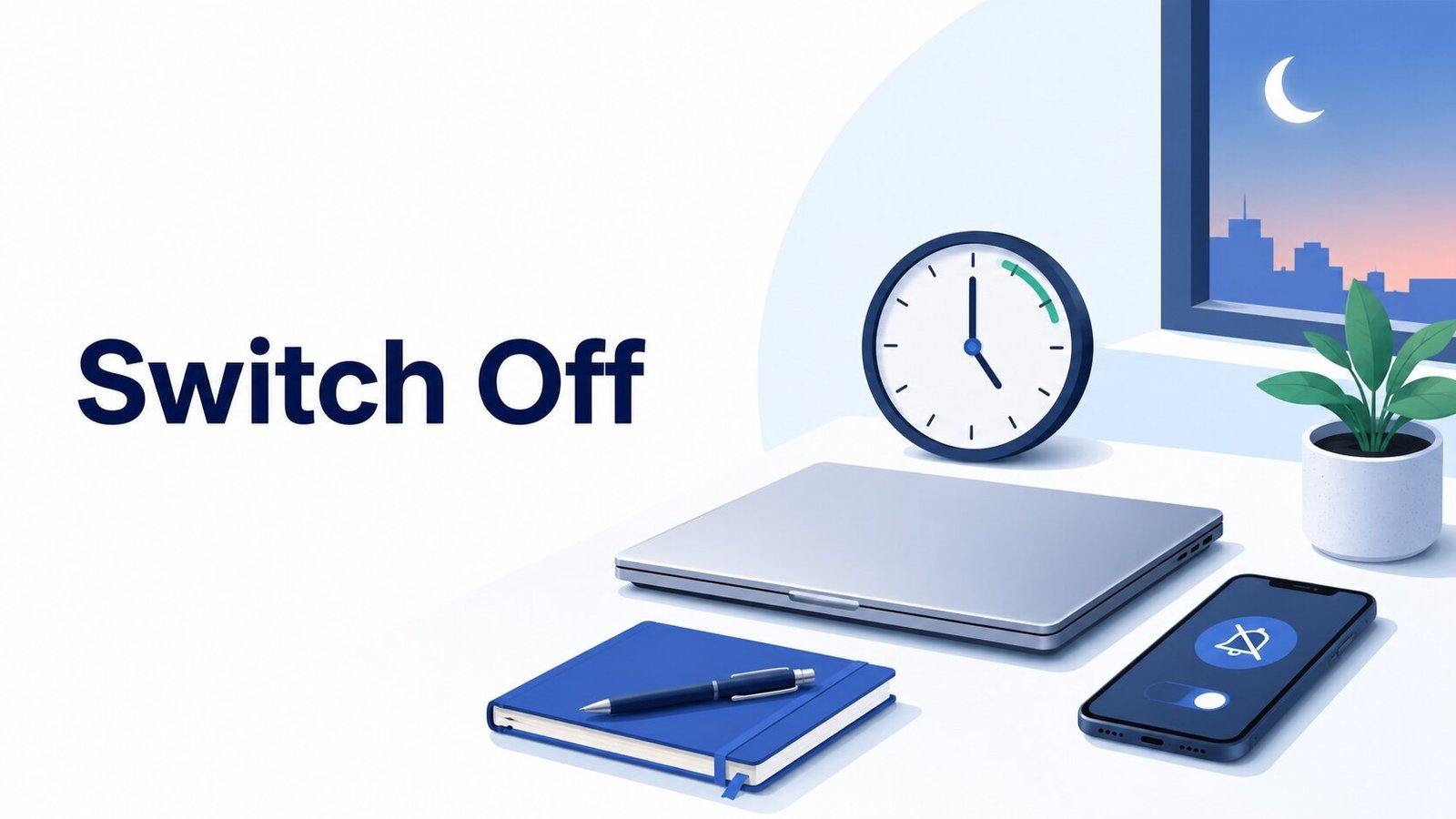
Knowing how to disconnect from work after hours is not always as simple as closing your laptop. You can stop working and still find yourself checking messages, replaying a conversation, or thinking about everything waiting for you tomorrow.
A clearer stopping point can make it easier to switch off after work. You do not need to finish every task or forget the day completely. You need enough closure and distance that work stops directing your attention.
What keeps you connected can be different from one day to the next. Before changing your evening routine, notice what is actually following you out of work.
Quick Overview
- Disconnecting from work means creating enough mental, digital, and practical distance from the workday.
- Unfinished tasks, notifications, shared spaces, and unclear availability can make it harder to switch off.
- A clear stopping point and consistent transition can make leaving work behind easier.
- If work regularly spills into personal time, the underlying work setup may need attention.
What Keeps You Connected to Work After Hours?
Closing your laptop is only one part of switching off. You can be physically away from work and still be mentally tied to unfinished tasks, messages, or a difficult conversation.
Researchers often describe this mental separation as psychological detachment from work. In everyday terms, it means being able to spend your non-work time without work continuing to occupy most of your attention.
A 2023 systematic review of 159 studies on psychological detachment examined what helps or prevents people from mentally disengaging from work, highlighting detachment as an important part of recovery from the workday.
What keeps that from happening is not always the same:
| What keeps pulling you back | What may help |
|---|---|
| Unfinished tasks | Create a clear stopping point before logging off |
| Repeated email or chat checking | Add digital distance |
| Work and personal life happening in the same space | Use a transition cue |
| Replaying a difficult interaction | Give the issue a clear next step |
| Worry about being unavailable | Clarify after-hours expectations |
| Working until everything is finished | Set a defined end to the workday |
You may recognize more than one of these. Start with the pattern that most often follows you into the evening rather than trying to change everything at once.
Give Your Workday a Clear Stopping Point
One reason work keeps following you into the evening is that the day never really feels finished. There is always another message to answer, another task you could improve, or something you could get a head start on for tomorrow.
Waiting until everything is done rarely creates a reliable stopping point. A more workable approach is to decide what done for today looks like, even when the larger workload is still unfinished.
Before you log off, capture unfinished work somewhere you trust. For anything important, make the next action clear enough that you will know how to restart without reconstructing the whole problem tomorrow.
It also helps to know where you will begin the next day. You do not need to plan your entire morning. One clear starting point can make unfinished work feel contained rather than unresolved.
A stopping point is not the same as completing everything. It is a deliberate decision that today’s work has reached a reasonable end and the rest can wait until you are working again.
Create Some Distance From Work
Even after you decide the workday is over, your surroundings can keep pulling you back into work mode.
The same desk, laptop, phone, and notifications can make the boundary surprisingly easy to cross. A small change in context gives the end of work something more concrete than the time on the clock.
If you commute, try not to turn the journey home into a final work session. Continuing with email, calls, or project messages can carry the workday with you even after you have left the workplace. Music, a podcast, quiet time, or simply leaving work input alone can make the journey a more useful transition.
If You Work From Home, Change the Context
Working from home removes the natural cue of physically leaving a workplace, but you can create a replacement.
Close the work apps, put the laptop away if you can, leave the work area for a few minutes, change clothes, or take a short walk. The specific cue matters less than choosing something realistic enough to repeat.
If your workspace is also where you relax, make the change as visible as possible. Clearing work materials from view, closing a work browser profile, or putting away your headset can help mark the shift into personal time.
You do not need an elaborate evening routine. A small, consistent change can be enough to make the workday feel more clearly finished.
Reduce the Digital Pull Back Into Work
Physical distance helps less if work keeps reappearing on your phone.
Silence nonessential work notifications after hours, remove work apps from your home screen, turn off badge counts, or use a separate work profile if your device allows it. If your role genuinely requires after-hours availability, define one clear route for urgent issues instead of leaving every channel open.
This matters because even brief after-hours contact can bring work back into your attention. In a month-long observational study of IT employees, more frequent after-hours work email was associated with poorer psychological detachment and sleep-related outcomes.
You do not have to make yourself impossible to reach. Reduce the routine prompts that make you check work when nothing actually requires your attention.
When Work Thoughts Follow You Into the Evening
Even with a good stopping point, work thoughts can still return later. Trying to force them away can sometimes give them even more attention.
A more useful response is to decide whether the thought needs capturing, clarifying, or leaving until tomorrow.
If You Suddenly Remember Something
Write it down somewhere you trust and leave it there.
You do not need to reopen your laptop just because you remembered a task at 8 PM. Once the reminder has a place to wait, return to what you were doing.
If You Are Stuck on an Unresolved Decision
Ask yourself what is actually missing.
Perhaps you need an answer from someone else, more information, or simply a fresh look in the morning. Note what would move the decision forward, then leave the problem there rather than repeatedly trying to solve it with the same information.
If You Keep Replaying a Difficult Interaction
Separate anything that may need action from the part that is simply replaying.
If a follow-up conversation is needed, note what you want to address and deal with it when you are back at work. If nothing useful can happen tonight, running through the exchange again is unlikely to change the outcome.
A work thought does not need to become evening work. Give it somewhere to wait, then return to your personal time.
Give Your Attention Somewhere Else to Go
Switching off becomes easier when your evening gives your attention somewhere different to settle.
If you finish work and remain in the same setting with nothing that changes the pace, work can stay mentally close even when you are no longer doing it.
What helps may depend on what the day took out of you:
| After work, you feel… | You might prefer… |
|---|---|
| Physically restless | A walk, stretching, or other light movement |
| Mentally overloaded | Something familiar and low-demand |
| Stuck on a work problem | An absorbing hobby or hands-on activity |
| Socially drained | Quiet time with fewer demands |
| Isolated | Relaxed time with someone you enjoy being around |
There is no single best after-work activity. A day full of conversations may leave you wanting quiet, while hours of solitary screen work may make movement or company more appealing.
Choose something that changes the pace of the day rather than simply filling the time until bed.
When Switching Off Is Not Just a Personal Habit
Sometimes the reason you cannot disconnect is not your evening routine. It is the way the work itself is set up.
If your workload regularly extends beyond normal hours, you are expected to respond late at night, or nobody is clear about what counts as genuinely urgent, switching off becomes much harder.
That can look like:
- the day’s workload rarely fitting inside the workday;
- after-hours messages creating an expectation of immediate replies;
- staying alert for something that might become urgent;
- availability expectations changing depending on the manager, client, or team.
In these situations, another evening habit may not solve the problem on its own. You may need clearer expectations around workload, availability, response times, or responsibility for genuine emergencies.
If availability or workload expectations are the main issue, setting boundaries at work may be the more useful next step. If the pressure is broader and affects the workday as well as your evenings, managing stress at work can help you look at the underlying causes more directly.
When the job regularly crosses into personal time, part of the solution may need to happen at work, not only after work.
END-OF-DAY RESET
A Simple Five-Minute Work Shutdown
Use this short routine before you finish for the day so unfinished work has a clear place to wait until tomorrow.
- Write down anything unfinished that still needs your attention.
- Choose the first task you will return to tomorrow.
- Send any closing update that genuinely cannot wait.
- Close work apps, tabs, and equipment.
- Start the cue that marks the beginning of your personal time.
Frequently Asked Questions
Should I Answer Work Emails After Hours?
Only if your role or agreed expectations require it. If you are not on call or responsible for urgent issues, an evening message does not automatically need an immediate reply.
Is It Normal to Think About Work After Hours?
Occasional work thoughts are common, especially after a demanding or unresolved day. If work regularly dominates your personal time or affects sleep, mood, or your ability to relax, it may need more attention.
How Long Should It Take to Switch Off After Work?
There is no fixed amount of time. Some days you may disconnect quickly, while stressful or unfinished work can take longer to settle from.