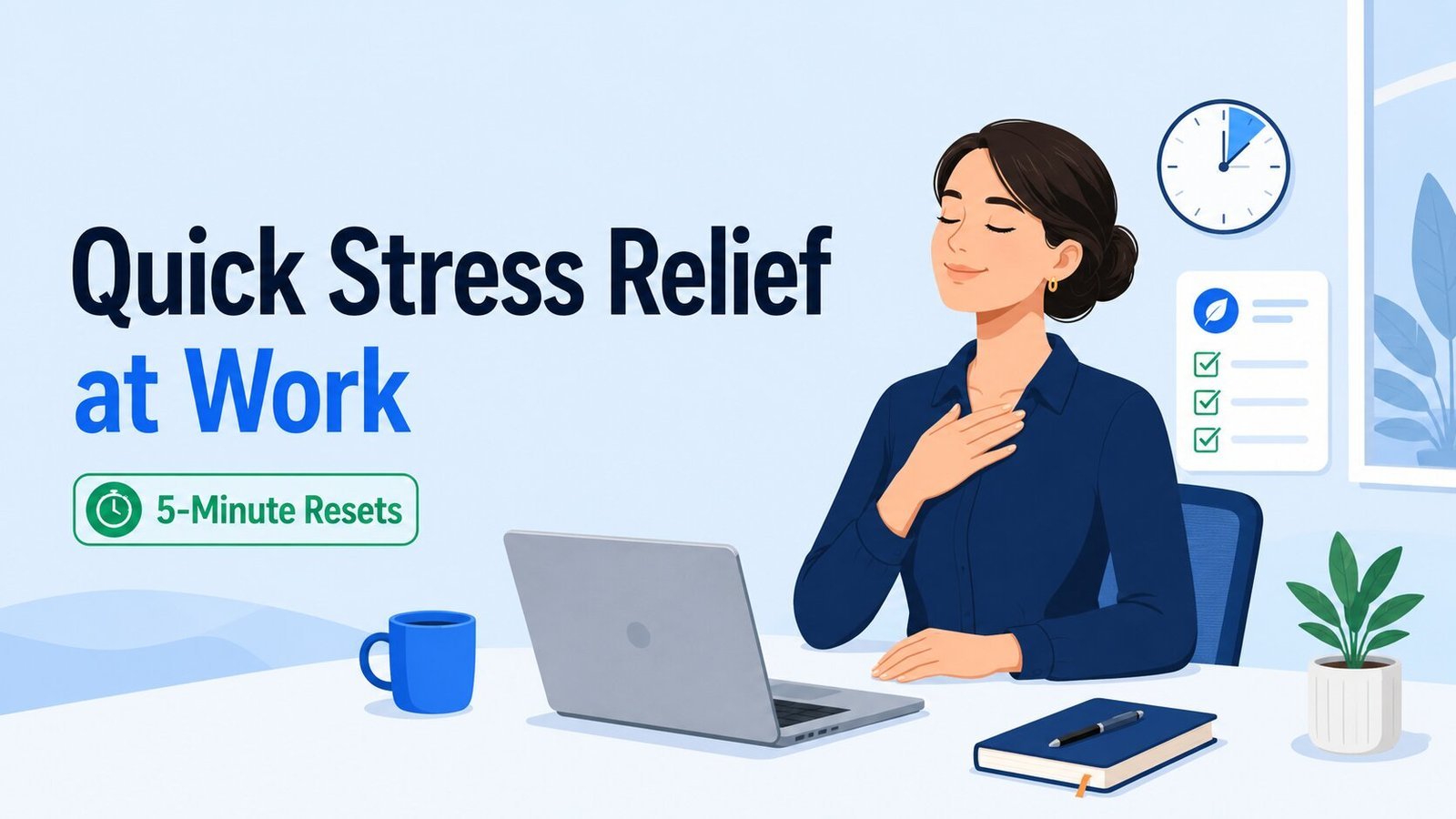
Work stress does not always build slowly. Sometimes it arrives all at once. A difficult message lands in your inbox, a deadline suddenly moves forward, or you leave one tense meeting knowing another starts in ten minutes.
In moments like these, quick stress relief techniques at work can give you a little space before the pressure carries into your next task, conversation, or decision. They will not remove the underlying problem, but a few minutes may help you settle enough to think more clearly about what to do next.
The most useful reset depends on what is happening right now. Racing thoughts, physical tension, frustration, and mental overload do not always respond to the same thing.
Quick Overview
- Quick stress relief at work can help you handle an immediate stressful moment more calmly.
- Different techniques work better for racing thoughts, physical tension, frustration, or mental overload.
- Most techniques can be used at your desk or during a short break.
- Recurring workplace stress may need more than a quick reset.
Which Quick Stress Relief Technique Fits the Moment?
When you are already stressed, choosing from a long list of ideas can become one more thing to think about. Start with what you are noticing in your body or mind, then choose a technique that matches it.
| If you notice… | Try… |
|---|---|
| Fast, shallow breathing or feeling physically keyed up | Slow breathing |
| Racing thoughts or difficulty staying present | Grounding with your senses |
| Tight shoulders, jaw, hands, or other muscle tension | Releasing physical tension |
| Restlessness after sitting for a long time | Brief movement |
| Too many demands competing for attention | A three-line mental reset |
| Anger or defensiveness after a message | Pausing before you reply |
| One stressful interpretation taking over | Putting the thought in perspective |
| Uncertainty about how to read a situation | A quick reality check |
| Ordinary tension that needs a light interruption | A brief moment of humor |
| One difficult meeting following you into the next | A between-meeting reset |
You do not need to find the “perfect” stress relief technique. Choose the one that best matches what you are noticing right now.
10 Ways to Ease Stress at Work in the Next Five Minutes
These techniques are meant for short, stressful moments during the workday, not for solving every source of workplace stress. Some address physical tension, while others are more useful when your thoughts, emotions, or workload are adding to the pressure.
1. Slow Your Breathing
When stress spikes, your breathing can become quicker and shallower without you noticing. Slowing it down for a few minutes gives you something simple and concrete to focus on.
Sit comfortably and let your breathing become a little slower than usual. You do not need a complicated count. Keep the breaths easy and unforced rather than taking unusually deep breaths.
One simple approach is to breathe in gently and let the exhale last a little longer. Continue for a few minutes if it feels comfortable.
This can be useful when you feel physically keyed up before a meeting, after a difficult message, or while waiting for something stressful to happen.

2. Ground Yourself With Your Senses
When your thoughts are racing, trying to reason through everything at once may add even more mental noise. Grounding brings some of your attention back to what is actually around you.
Pause and notice a few details. You might focus on your feet against the floor, the support of the chair, a sound nearby, or the texture and color of an object on your desk.
You do not have to complete a long sensory checklist. Simply noticing what you can see, hear, and physically feel can give your attention somewhere concrete to go.
The 5-4-3-2-1 method is a more structured version of the same idea. Cleveland Clinic describes it as a grounding exercise that uses the five senses to bring attention back to the present, and notes that it can be used while sitting at a desk.
A more structured version is the 5-4-3-2-1 grounding technique, which uses the five senses to bring attention back to the present moment. You do not need to complete the full sequence every time. A shorter sensory check may be enough when you need something practical during the workday.
3. Release the Physical Tension You’re Holding
Stress often shows up in places you are not paying much attention to, especially your jaw, shoulders, hands, and upper back.
Take a moment to notice where you are bracing. Unclench your jaw, lower your shoulders, loosen your grip on the mouse or phone, and let your hands rest.
If one area feels tense, you can gently tighten those muscles for a few seconds and then release them. This is a simplified version of the principle used in progressive muscle relaxation, which focuses on noticing the difference between muscle tension and relaxation.
You do not need to work through your entire body. For a quick desk reset, focus on the areas where you are actually noticing tension.

4. Get Up and Move for a Few Minutes
After a long stretch in the same chair and position, movement can give the stressful moment a physical break.
Stand up, walk to refill your water, stretch your legs, or take a short lap around the room if you can. It does not need to become a workout.
This is especially practical after concentrated screen work or a long period of sitting. If you cannot leave your desk, stand, change position, or take a few steps nearby.
Keep the break brief enough that it feels easy to use during a normal workday.
5. Do a Three-Line Mental Reset
Stress can make several tasks seem equally urgent, even when they are not. Writing down what is happening can make the immediate situation easier to sort through.
Take a blank note and answer three questions:
- What is stressing me right now?
- What needs my attention next?
- What can wait?
Keep the answers short. This is not a full planning exercise or a new to-do list. You are separating the immediate pressure from everything else competing for attention.
You may discover that only one thing actually needs action in the next hour. If deciding what deserves attention is a recurring problem rather than a one-off stressful moment, a broader approach to prioritizing tasks at work can help.
6. Pause Before You Reply
A stressful message can pull you into answering faster than you normally would. That is often when frustration and assumptions begin shaping the response.
Unless the situation genuinely requires an immediate answer, leave the message alone for a few minutes. When you return, read it again and separate what was actually written from what you first assumed it meant.
Then decide what kind of response the situation needs. A short written answer may be enough. If the exchange is sensitive or increasingly unclear, a live conversation may work better than another long message.
A brief pause can keep one frustrating interaction from turning into a larger communication problem.
7. Put One Stressful Thought in Perspective
Sometimes the pressure comes less from what has happened and more from the conclusion your mind has already reached.
You might receive a short reply from your manager and assume they are unhappy with your work. Or one mistake begins to seem like evidence that the entire project is going badly.
When that happens, ask yourself:
- What do I actually know about the situation?
- What am I assuming without clear evidence?
- Is there a more realistic way to interpret what happened?
You are not trying to replace an uncomfortable thought with an artificially positive one. A more accurate interpretation is enough.
Instead of “That meeting went badly, so everyone probably thinks I handled it poorly,” you might arrive at “One part of the meeting was uncomfortable, but I do not know how everyone viewed it.”
8. Get a Quick Reality Check From Someone You Trust
When you are close to a stressful situation, it can be difficult to tell whether you are missing something or simply overthinking it.
A short conversation with someone you trust can give you another perspective. Choose someone who understands enough of the context to be useful and who is likely to give you a clear answer rather than simply agree with you.
Example wording
I may be overthinking this. Can I quickly check how you’re reading the situation?
You are not asking the other person to solve the problem. You are checking your view of it before uncertainty grows into a bigger source of stress.
Keep workplace confidentiality in mind when choosing what to share. You may be able to describe the situation without disclosing sensitive information.
9. Give Yourself a Brief Moment of Humor
Not every stressful moment needs more analysis. Sometimes an ordinary patch of workday tension benefits from a small change in emotional tone.
If the situation allows, spend a minute or two with something you know makes you laugh. It might be a funny message from a friend, a familiar clip, or a light exchange with a coworker.
Keep it brief and intentional rather than turning the break into twenty minutes of scrolling.
Humor is not a way to dismiss a serious workplace problem or avoid something that needs action. Save it for those ordinary moments when you simply need a little distance from the tension before returning to work.
10. Reset Between Stressful Meetings
A difficult meeting can follow you straight into the next one when there is little space between them.
Use whatever gap you have to close out the first conversation before opening the next:
- Write down anything from the meeting that you genuinely need to remember.
- Capture any immediate follow-up so you do not have to keep rehearsing it mentally.
- Close the meeting notes, chat, or window once you are done with them.
- Give yourself a brief pause before starting the next conversation or task.
You are not trying to resolve everything that happened in a few minutes. You are giving the previous meeting a stopping point so it does not automatically occupy the next one.
If back-to-back calls leave little room to recover throughout the day, the broader issue may be meeting overload rather than how well you reset between meetings.
When a Quick Reset Is Not Enough
Quick stress relief can help with your response to a stressful moment. It cannot necessarily change what keeps creating the stress.
If the same pressure keeps returning, look at what sits underneath it. The problem might be an unrealistic workload, conflicting priorities, unclear expectations, repeated conflict, constant interruptions, or too little time to recover between demands.
At that point, managing stress at work means looking at the source as well as how you respond to it. If repeated workload or availability demands are part of the pattern, clearer boundaries at work may also be part of the solution.
That distinction matters because workplace stress is not always something an individual can solve with better coping habits. The CDC’s guidance on worker mental health emphasizes the role of working conditions, management practices, and workplace policies in reducing and preventing job-related stress.
A quick reset still has a useful role. It helps with the moment in front of you while leaving room to address a recurring problem at the level where it is actually happening.
Keep in mind
These techniques are intended for everyday work stress and general information. If stress feels overwhelming, persists, or begins affecting your sleep, mood, concentration, or daily life, consider speaking with a qualified health professional.
Frequently Asked Questions
How Can I Calm Down Quickly When I’m Stressed at Work?
Start with the part of the stress you notice most. Slow breathing may suit physical tension or feeling keyed up, while grounding can be more useful when your thoughts are racing. If frustration is driving the moment, give yourself a brief pause before responding.
What Can I Do to Reduce Stress at Work Without Leaving My Desk?
You can slow your breathing, ground yourself with your senses, release tension in your jaw or shoulders, or use the three-line mental reset. These techniques require little space and can be done without leaving your workspace.
How Do I Stop Overthinking at Work?
Separate what you know from what you are assuming. If your mind keeps moving toward the worst interpretation, check the evidence you actually have and consider a more realistic explanation. Grounding can also help when your thoughts keep circling without leading anywhere useful.
Is It Normal to Feel Stressed at Work Every Day?
Work stress can happen frequently, but daily stress is worth paying attention to rather than automatically treating it as something you should push through. Look for recurring causes such as workload, unclear expectations, conflict, or lack of recovery time. If the stress is persistent, overwhelming, or affecting daily life, consider seeking appropriate professional support.